Borodinsky Sourdough Bread
Rye · pan · scalded
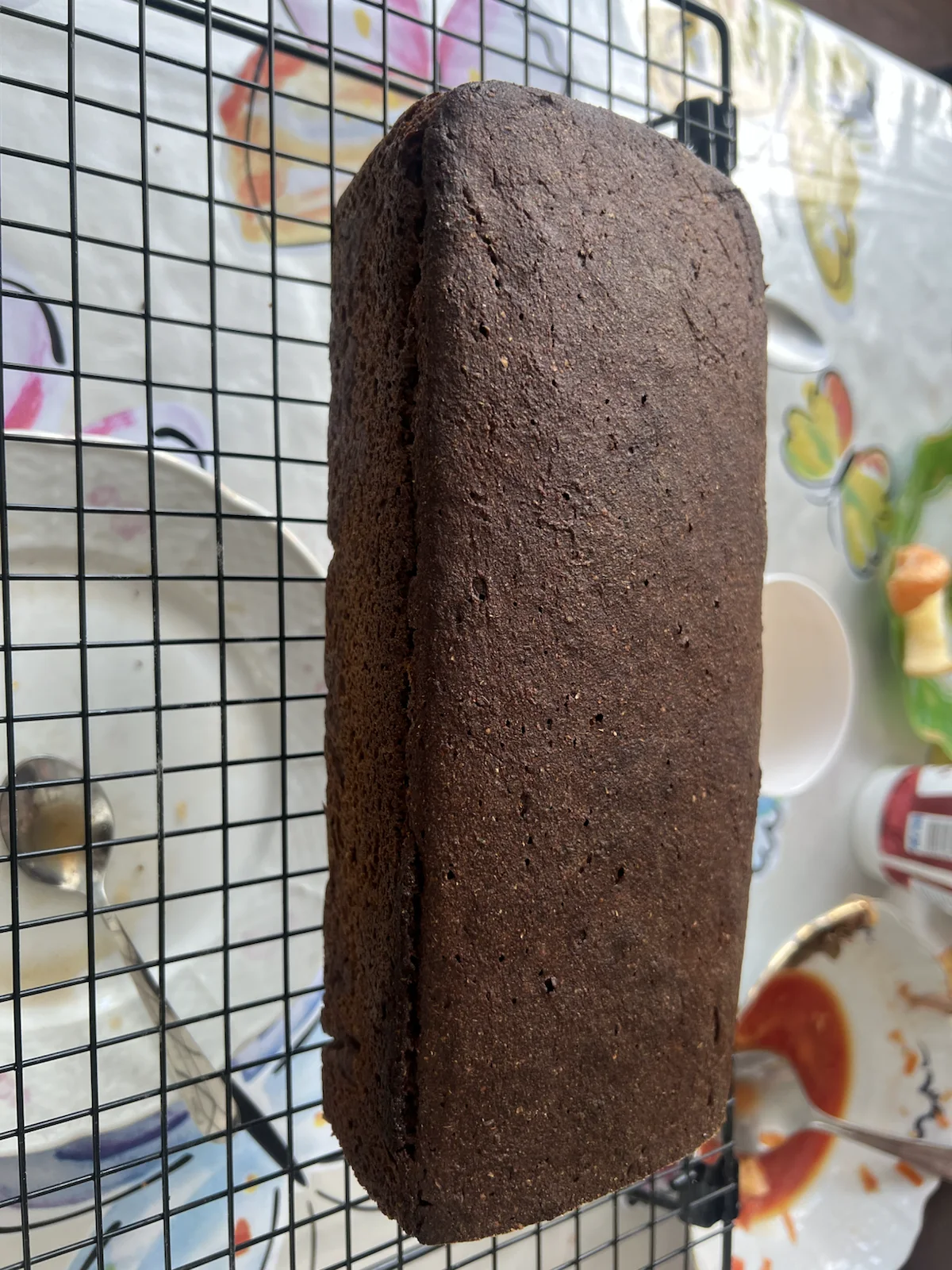
Borodinsky scalded rye on rye sourdough, red malt, coriander, caraway, and mandatory crumb maturation.
Live timing needs JavaScript enabled.
Calculated for the current time; the worksheet lets you set any start.
Recipe
Current recipe
For baking now: the final working formula, ingredients, steps, and baking worksheet.
Taste & texture
The crumb is tight, dense, and moist — close-grained like cake but with a satisfying chew; after 36-48 h it firms up cleanly and the knife leaves no residue. The crust is firm and mahogany-dark. Flavour opens with malty-chocolate sweetness from the red malt and molasses, then the sourdough lactic tang pulls it back into balance. Coriander registers as a bright citrusy-peppery note; caraway adds a quieter, slightly fruity bite underneath. The loaf keeps well for several days, staying moist as the scald continues to bind water.
As described by: The Rye Baker — Auerman Borodinsky , Beets and Bones — Russian Sourdough Borodinsky Bread , Flavor365 — Borodinsky Bread: Everything You Need to Know
Baking worksheet
Good to know
Why is the Sauerteig nearly twice as large, with almost no water left in the dough?
The formula totals are unchanged: 549.5 g flour and 512.5 g water. Seventy-five grams of flour and 75 g of water moved from the final dough into the Sauerteig, so the dough now takes 200 g rye flour and 25 g water instead of 275 and 100. The consistency is the same thick paste; the water simply arrives already bound in the preferment and the scald. The neighbouring scalded ryes work the same way — Riga rye takes only 20 g of free water in the final dough.
Why increase the share of prefermented flour at all?
Rye dough is held together by acid, not gluten: acidity suppresses α-amylase, which would otherwise thin the gelatinised starch and leave a sticky crumb. The former 15.9% was low for a dark whole-grain rye — Auerman as presented by Stanley Ginsberg runs 31.3%, the Latgalian and Riga loaves in this course use 30%, and the Vitebsk loaf on light sifted flour uses 25%. The new 29.6% puts Borodinsky back in that range.
Why no refrigerator step for the Sauerteig anymore?
The refrigerator solved a calendar problem, not a technical one: the preferment ripened in four morning hours while the mix was only due the next day. Both recorded bakes show the cost — it had to be warmed in the oven for about 1 h 20 min, and on 25 April it came to the mix with no sourness at all. The 1:6:6 ratio puts the peak in the morning, so the cold step is no longer needed: the Sauerteig goes into the dough warm and active.
What if my kitchen runs above 25 °C and the Sauerteig over-ferments overnight?
Reduce the seed: 20 g of starter instead of 25 g at the same 150 g flour and 150 g water pushes the peak roughly an hour or so later. For a kitchen below 21 °C do the opposite — 30 g of starter, or build it an hour earlier. The target is the same either way: at mixing time the Sauerteig should be rising or at peak, not collapsed.
Why not change sweetness now?
The previous tasting was mixed with wet-crumb and plastic-storage effects. First repeat with normal storage, then change sugar or molasses separately.
Can I skip white malt?
Yes, but the scald will be less sweet and less saccharified. Record it as a deviation.
Why not leave the scald on the counter overnight after 65 °C?
After saccharification it is wet, sweet, and close to neutral; refrigeration lowers the risk of ropy crumb defects.
Borodinsky is not a simple rye loaf: it is a controlled scalded-rye system built from rye sourdough, a 65 °C scald, red and white malt, coriander, caraway, sugar/molasses, stepped baking, and crumb maturation. The scald is what sets it apart from ordinary sour rye — it is a deliberately enzymatic, sweet, dark component that has to be built before the dough is even mixed.
How Borodinsky Is Baked Around the World and Why
Borodinsky is a Russian and post-Soviet classic, codified in the Soviet standard GOST 5309-50 and tied by legend to the Moscow region (the Borodino battlefield), but the same logic — scalded dark rye, sweetened, scented with coriander — repeats across the rye-belt of northern and eastern Europe, just with different accents.
In Russia and Belarus the loaf is baked in a tin to a glossy near-black top, sweetened with molasses or sugar, and finished with whole coriander pressed onto the crust; coriander is the signature note that makes it read instantly as “Borodinsky” rather than generic black bread. In the Baltics — Latvia’s rupjmaize, Lithuania’s juoda duona — the same scalded-rye base leans sweeter and sourer at once, often using caraway instead of coriander and sometimes hearth-baked rather than panned. German Vollkornbrot and pumpernickel share the scald-and-long-bake DNA but drop the spice and push the bake far longer and lower, so colour comes from hours of heat and Maillard/caramelization rather than from added malt. Finnish and Estonian dark ryes sit in between, often more sour, sometimes with a touch of malt syrup.
Why this shape recurs is enzymatic, not stylistic. Rye starch gelatinizes at a low temperature and rye is rich in amylase, so an unmanaged rye dough turns to gum. A scald (Brühstück) pre-gelatinizes part of the flour and lets a controlled, time-limited saccharification happen on purpose, at 65 °C, where the white malt and the flour’s own enzymes convert starch to sugars before the bake — feeding flavour and crust colour while binding water so the dense crumb stays moist for days. Sourdough acidity is the brake: it tightens the rye pentosans, slows runaway enzyme activity, and keeps the high-hydration paste structured enough to rise in a tin. Pan baking and a long stepped descent (hot start, then progressively cooler) set the crust and drive heat to the centre of a loaf that conducts poorly. The 24–48 h rest is not optional polish — in scalded rye it is when moisture redistributes and the crumb stops being sticky.
Theory
Borodinsky carries many variables at once: rye sourdough, scald, malt, sugar/molasses, coriander, caraway, high hydration, pan baking, storage, and crumb rest. They are easiest to read when they are not all changed together. The controls that decide the loaf are starter maturity, a clean 65 °C scald, proof height, internal temperature, storage method, and the crumb judged at 24–48 h. Because the dough is a high-hydration paste with almost no gluten, structure comes from pentosans and acidity rather than kneading, and the loaf is steered by timing and temperature far more than by mixing.
How the Borodinsky System Works
Borodinsky is not just “rye bread plus coriander.” Its flavour comes from a controlled balance:
| Element | Job |
|---|---|
| Rye sourdough | Acidity, gas, enzyme control, fermented rye aroma |
| Malt scald | Dark colour, sweetness, malt aroma, water binding |
| Sugar/molasses | Sweetness, colour, moisture, and roundness against acidity |
| Coriander/caraway | Style-defining aroma; too much quickly dominates |
| Pan proof | Volume and structure in paste-like dough |
| Crumb rest | Moisture redistribution and cleaner slicing |
If the bread is bland, sticky, sour, or dense, changing everything at once tells you nothing. Adjust one variable only after storage and rested crumb are recorded.
Sourdough and Scald Have Different Jobs
Sourdough is the acid and fermentation engine. The scald is a flavour and water-binding component. A good scald cannot rescue exhausted sourdough, and strong sourdough cannot fully replace malt scald character.
The scald should be uniform, dark, and hydrated without dry pockets. The current working process is 3 h at 65 °C, then cooling and refrigeration. Do not leave the sweet wet scald overnight on the counter in this control version. The useful record is time, temperature, smell, and texture before mixing.
The Sauerteig takes the opposite route: it stays on the counter for 13–14 hours at 22–24 °C and never sees the refrigerator. The two components share an evening but not a temperature.
How Much Flour to Preferment
The prefermented share is not a flavour dial but the way rye enzymes are controlled. Acid from the preferment suppresses α-amylase; with too little of it, amylase thins the gelatinised starch and the crumb stays sticky no matter how well the loaf is baked. Hence the reference points:
| Bread | Flour in the preferment | Note |
|---|---|---|
| Vitebsk, light sifted rye | 25% | Sifted flour is lower in enzymes, so less acid is needed |
| Riga, Latgalian | 30% | Dark scalded ryes of the same family |
| Borodinsky after Auerman, as presented by Ginsberg | 31.3% | The sponge ferments 12–16 h at 21 °C |
| Home reconstruction of GOST 5309-50 | about 50% | There the scald ferments together with the sponge |
| Borodinsky, this sheet | 29.6% | 162.5 g of 549.5 g; previously 15.9% |
The seed ratio doubles as a timer. The approximate peak arrives after roughly 4 · (1 + log₂ (flour ÷ starter)) hours: 1:3 gives about 10 hours, 1:6 about 14. That is why the former 25+75+75 build could not stand a night without over-souring, while 25+150+150 peaks exactly at the morning mix. A kitchen above 25 °C speeds this up — drop the seed to 20 g; below 21 °C slows it down — raise it to 30 g.
Why the Cycle Takes Two Days, Not Three
Three refreshments are needed to bring the culture from the refrigerator to working strength, and they fill day 1 and day 2. After that there is a fork: build the preferment in the morning and wait a full day for the mix, or build it in the evening and mix the next morning. The first path needs the refrigerator as a pause and adds the extra night; the second uses the night for what it is good at — ripening.
This sheet follows the second path. Refreshment 3 ripens by 18:00 on day 2, the Sauerteig and the scald go up together at that point, the scald is refrigerated by 21:40, and nothing needs attention until morning. The mix is at 08:00 on day 3 and the loaf leaves the oven at 13:05 — 51 hours from the first refreshment instead of 65.
Proofing and Ceramic/Pan Risk
Pan rye is ready by height and surface state, not by the timer alone. Underproofing gives a heavy compact crumb. Overproofing gives collapse, strong sourness, large ruptures, or a weakened top.
Cold ceramic or a heavy pan can delay centre heating. That means a loaf can look dark outside while the crumb still needs time. Internal temperature and rested crumb matter more than colour.
Storage and Maturation
Borodinsky should not be judged from a hot slice. For the first day, avoid sealing a warm loaf tightly in plastic because trapped steam can turn the crust and surface crumb wet. A 24–48 h rest gives a cleaner read on moisture, acidity, sweetness, malt, coriander, caraway, and salt.
If Something Goes Wrong
- Bland but well risen → check salt, malt, coriander, or sourdough maturity.
- Sharp sourness → the Sauerteig went well past its peak overnight. Drop the seed to 20 g or mix earlier.
- Barely any rise by morning → the kitchen was below 21 °C, or the culture went in weak. Raise the seed to 30 g and take refreshment 3 closer to its peak.
- Sticky knife after 24 h → the prefermented share is already at 29.6%, so look at the bake, internal temperature, and storage instead.
- Dry crumb → bake length, storage, or the bound-water components (scald, molasses).
- Good crumb but weak aroma → scald time, malt quality, coriander freshness.
Theory Sources
- GOST 5309-50 reconstruction (Borodinsky) — breakdown of the recipe and profile of the Borodinsky style per the standard (80% wholemeal rye / 15% type-II wheat / 5% red malt).
- Sourdough Bread Quality: Facts and Factors — review of sourdough, acidity, and bread quality.
- Arabinoxylans as Functional Food Ingredients: A Review — review of water binding relevant to rye crumb.
- Chemistry of bread aroma: A review — review of fermentation and baking effects on bread aroma.
Home Adaptation
Borodinsky can be managed at home as a controlled pan bread. The professional topics — scald, acidity, malt, spice, moisture, and storage — become simple records: scald time and condition, starter readiness, proof height, internal temperature, storage method, and crumb after rest.
The home risk is changing everything at once: water, sugar/molasses, malt, spice, and bake profile. Change only one parameter after a clean storage check and a crumb check at 24–48 h.
Ingredients
Change any amount — the rest rescale by the bread’s formula.
| Component | Grams | Baker's % |
|---|---|---|
| Sauerteig preferment | g | 59.15% |
| Brühstück scald | g | 89.17% |
| Whole-grain rye flour in final dough | g | 36.4% |
| Strong white bread flour | g | 11.46% |
| Whole-grain wheat flour | g | 2.18% |
| Water in final dough | g | 4.55% |
| Salt | g | 1.82% |
| Sugar | g | 6.92% |
| Molasses or honey | g | 4.55% |
Preferments, scalds, and old dough are shown as prepared components; their composition is listed in the row details and worksheet.
Ingredient details
Sauerteig preferment
- Composition
- 25 g active rye starter + 150 g whole-grain rye flour + 150 g water
- Schedule
- 13–14 h at 22–24 °C: built in the evening right after the third refreshment, at peak by the morning mix. No refrigerator step
- Prefermented flour
- 162.5 g of 549.5 g — 29.6%; the 1:6:6 seed ratio is chosen so the peak lands in the morning
Brühstück scald
- Composition
- 112 g rye flour, 28 g red rye malt, 12 g white malt, 8 g coriander, 5 g caraway, 325 g boiling water
- Schedule
- 3 h at 65 °C in the evening, cool 30–40 min, then refrigerate until the morning mix
Strong white bread flour
- Part of a substitute
- together with 12 g of whole-grain wheat this replaces 75 g of first-grade flour, which the author cannot buy
- Brand the author uses
- MukaMuka Artisan Superiore 13.5% (type 00; mukamuka.ru)
- Alternatives
- any bread flour at 12–14% protein
Whole-grain wheat flour
- Role
- the second half of the first-grade substitute: it supplies the ash and bran particles a type 00 flour lacks
- Why 5:1
- First-grade flour differs from the highest grade not in strength but in ash: GOST 26574-2017, table 2, allows up to 0.75% against 0.55% and whiteness of at least 36 against 54 units; the gluten requirement is actually higher — at least 30% against 28%. Artisan Superiore is a type 00 flour, so its ash matches the highest grade. A 5:1 blend gives a calculated ash of about 0.74% assuming a typical 1.7% for whole-grain wheat; the real spread is 0.71–0.79% depending on the batch, with the GOST ceiling for wholemeal at 2.0%. On strength Superiore is not the weaker option: its 13.5% protein works out to roughly 34% wet gluten against the 30% minimum (an estimate using the usual factor of 2.5, not a measurement). The difference from mill-made first-grade flour is the grind: the bran particles in a blend are coarser.
- Brand the author uses
- MukaMuka whole-grain wheat (mukamuka.ru)
- Alternatives
- mill-made first-grade flour — then use 75 g of it alone instead of this pair
Water in final dough
- Range
- 10–45 g by consistency; target texture is a thick paste, not stiff dough
- Why so little
- total water is unchanged at 512.5 g: 75 g moved into the Sauerteig together with 75 g of flour. Dough consistency is the same, there is simply less free water left for adjustment
- Brand the author uses
- Tap water through Barrier Iron x2 filter
- Alternatives
- any filtered or bottled drinking water
Salt
- Brand the author uses
- Pink Himalayan salt
- Alternatives
- sea or table salt (avoid iodized)
Sugar
- Brand the author uses
- White sugar, no specific brand
- Alternatives
- any white sugar; for brown — Mistral demerara
Conditions and equipment
Conditions
- Level
- advanced rye; a 60/40 rye-wheat loaf is an easier starting point
- Kitchen temperature
- about 22–24 °C; record the actual temperature
- Doneness temperature
- 98–99 °C internal; probe required
- Main risk
- confusing technological crumb moisture with the storage effect of sealing the loaf in plastic
- What the next bake tests
- the schedule was rearranged in v4.0 and has not been baked yet: the Sauerteig now carries 29.6% of the flour and ferments overnight at room temperature instead of 4 h warm plus a day of cold. Record its morning state, dough temperature, actual proof length, and knife stickiness at 24–48 h.
Equipment
- Pan
- Emile Henry Petit Moule Cake 1.1 L
- Oven
- Haier HOQ-F6QS, top-bottom heat, hand steam/steam generator, 1 upper stone during preheat
- Mixing
- Kenwood KVC85.004SI, K-beater on Min; hook not used
- Control
- probe thermometer, scale, dough-height notes
Nutrition: Borodinsky bread
Bread nutrition facts
Per 100 g of bread
194 kcal
protein 5.2 g · fat 1.2 g · carbs 40.6 g
Per slice (50 g)
97 kcal
protein 2.6 g · fat 0.6 g · carbs 20.3 g
Automatic calculation from USDA + Skurikhin database for the baked loaf after evaporation. Numbers are approximate: 1) the database covers ingredients, not finished dough; 2) bake water loss is assumed at 10% — actual loss depends on crust, time, and pan. Add 5–10% in calorie trackers if needed.
Borodinsky is a dense rye sourdough with malt, coriander, and honey. It is flavourful and filling, but because of the sweet-sour profile and density it is best eaten in thin slices.
- Digestion
- Rye sourdough and dense crumb usually give longer satiety than white bread. Malt and honey add flavour plus some simple sugars, so the serving still matters.
- Helpful or harmful
- The useful side is rye, fermentation, spices, and satiety. The risk is large slices plus sweet or fatty additions.
- Amount
- Often 1–2 thin slices, about 30–60 g, are enough. Taste one piece plain first.
- Best pairings
- Good with fish, eggs, cottage cheese, mild cheese, vegetables, herbs, borscht, or cabbage soup. Jam, honey, and sweet tea are occasional dessert pairings.
How to eat
- Post-bake rest is required: mature crumb slices better and feels better in the mouth.
- Use Borodinsky as a flavour accent on the plate rather than a large starch base.
Limits
- Contains gluten, honey, and noticeable acidity.
- For diabetes or blood glucose control, count the starch portion as well as the honey.
Instructions
-
Refresh starter
Run three refreshments: 1:2:2 → 1:3:3 → 1:4:4, builds 10+20+20 → 8+24+24 → 10+40+40. Time them so refreshment 3 ripens in the evening — that is when the evening work begins. Use 25 g active starter in the Sauerteig and save 15–20 g as the ongoing starter.
-
Make scald
In the evening: hold 112 g rye flour, 28 g red malt, 12 g white malt, 8 g coriander, 5 g caraway, and 325 g boiling water for 3 h at 65 °C. Cool 30–40 min and refrigerate until morning.
-
Build the Sauerteig overnight
At the same time as the scald: hold 25 g active starter, 150 g rye flour, and 150 g water for 13–14 h at 22–24 °C. The 1:6:6 ratio is timed for the night, so the Sauerteig peaks by morning. No refrigerator step.
-
Mix
In the morning take only the scald out of the refrigerator. Mix all Sauerteig, all scald, 200 g rye flour, 75 g wheat flour, 10 g salt, 38 g sugar, 25 g molasses/honey, and 25 g warm water with Kenwood KVC85.004SI and K-beater on Min 3–5 min.
-
Proof
In the Emile Henry pan: about 2–2.5 h on the dedicated proofing mode at 35 °C, then 60 min on the counter during oven preheat. Bake at 1.5–1.8x rise with fine surface cracks, not by the timer.
-
Bake
250 °C 10 min → 200 °C 25 min → 170 °C 30 min → 140 °C 20 min. For the control repeat, bake without steam; the 8 May result is still n=1. Target 98–99 °C internal.
-
Mature
Cool 2–3 h uncovered on a rack, then wrap in cotton/linen/towel. No plastic during the first day. Slice after 24 h.
Version history
Show version history
- v4.1August 3, 2026
- Problem
- The formula called for first-grade wheat flour, which the author cannot buy: MukaMuka does not make one, so the “brand the author uses” note named a product that does not exist.
- Change
- The ingredient is split into what actually goes into the dough: 63 g of strong white bread flour (MukaMuka Artisan Superiore 13.5%, type 00) and 12 g of whole-grain wheat. The 5:1 ratio brings the ash up to the first-grade limit of GOST 26574-2017, table 2 — no more than 0.75% against 0.55% for the highest grade. Total flour, water, salt and every other ingredient are unchanged; only the baker's percentages of these two entries, the worksheet lines and the formula summary were recalculated.
- Result
- The recipe now lists flour that can actually be bought. A reader who has mill-made first-grade flour simply takes 75 g of it instead of this pair.
- Conclusion
- Not yet verified by baking: on calculated ash and strength the blend matches first-grade flour, but its bran particles are coarser than a mill grind. If the crumb turns out noticeably rougher, reduce the whole-grain share.
- v4.0August 3, 2026
- Problem
- The Sauerteig carried only 15.9% of the recipe flour (87.5 g of 549.5 g) — half of what the neighbouring scalded ryes in this course use and two to three times less than classic Borodinsky schemes. That left too little acid to hold rye amylase in check, and the 25 April log recorded a weak preferment with no sourness. The second problem was an extra day: the Sauerteig ripened for four morning hours and then sat in the refrigerator for 21.5 hours purely to meet the next morning's mix, and both bakes still needed about 1 h 20 min of warming before mixing.
- Change
- The Sauerteig grows from 25+75+75 to 25+150+150 (a 1:6:6 seed ratio) and now ferments overnight at 22–24 °C — 29.6% prefermented flour instead of 15.9%. The 75 g of flour and 75 g of water it gained were taken out of the final dough: 200 g rye flour instead of 275 g, 25 g water instead of 100 g. Formula totals are unchanged: 549.5 g flour, 512.5 g water, 10 g salt, about 1180 g of dough. The schedule was rebuilt: refreshments 1–3 fill day 1 and day 2, the Sauerteig and the scald both go up on the evening of day 2, and the mix happens on the morning of day 3; the cold-hold step is gone and the cycle drops from 64 h 35 min to 51 h 5 min. Two outstanding log findings were folded in as well: a 3–5 minute mix instead of 1–2, and the dedicated 35 °C proofing mode instead of the top-bottom 30 °C setting that actually holds around 40 °C.
- Result
- After the last refreshment the evening work happens in one block, the night passes with no hands-on steps, and the dough is mixed first thing in the morning — no warming required.
- Conclusion
- The schedule is rearranged but not yet baked. The next bake tests three things: whether the 1:6:6 Sauerteig peaks by morning without over-souring, whether the warm preferment shortens the proof, and whether the higher prefermented-flour share changes knife stickiness at 24–48 h.
- v3.8May 20, 2026
- Problem
- The working sheet did not show the full cooling, storage, and 24 h slicing window clearly enough.
- Change
- The final Cooling, storage, slice step is now a range from 8 May 13:35 to 9 May 13:35; prepTime and totalTime stay tied to the bake start and oven exit.
- Result
- The published recipe now separates process timing from evaluation timing: bread readiness is judged after the crumb has stabilized, but totalTime ends at oven exit.
- Conclusion
- Borodinsky conclusions should be recorded only after correct cooling, storage, and at least 24 h of maturation.
- v3.7May 8, 2026
- Problem
- After the 8 May bake, the knowledge-base checks needed to be reflected on the public page: no steam, hand mixing time, and storage after early slicing.
- Change
- The formula did not change. Added that steam is currently optional for the Emile Henry Borodinsky pan loaf after one no-defect bake at 99.2 °C internal; actual Danish-whisk mixing took about 4–5 min; early slicing and countertop storage are not a clean ideal-storage check.
- Result
- The next Borodinsky can be repeated as a dry bake without mixing the steam variable with sweetness, water, or spice changes.
- Conclusion
- If a second no-steam repeat is also clean, this can become a stronger personal oven/pan rule.
- v3.6May 8, 2026
- Problem
- The English page still carried the old simplified Borodinsky formula while the Russian page and working sheet had moved to the current Emile Henry v3.6 process.
- Change
- Synchronized ingredients, scald, Sauerteig, proofing, stepped bake, storage, images, and the expanded theory with the Russian current recipe.
- Result
- The English Borodinsky page now describes the same working formula as the Russian page.
- Conclusion
- Do not change sweetness or spices before the 24–48 h crumb and storage assessment.
- v3.5May 8, 2026
- Problem
- The 8 May bake showed the working sheet needed visible quantities on each step, markdown/CSV export, and a realistic cold-ceramic proof schedule.
- Change
- Added per-step quantities, the Emile Henry proof schedule, base 100 g final water, and a note that steam is optional for this pan loaf.
- Result
- The kitchen sheet can be followed without reconstructing ingredient amounts from the formula.
- Conclusion
- Keep sweetness and spices unchanged until the 24–48 h tasting.
- v3.4May 5, 2026
- Problem
- The worksheet used broad labels like morning and evening, making shifted starts hard to follow.
- Change
- Added concrete times and a calculator from the first refreshment start.
- Result
- The sheet can recalculate the full schedule when the actual start shifts.
- Conclusion
- Timing is a working plan; starter, scald, and proof state still decide readiness.
- v3.3May 5, 2026
- Problem
- The English Borodinsky page needed the expanded theory standard used by the current lessons.
- Change
- Added theory for the Borodinsky system, sourdough/scald roles, proofing risks, storage, and sources.
- Result
- This recipe now explains why this bread should be adjusted one variable at a time.
- Conclusion
- Diagnose storage, rested crumb, acidity, sweetness, malt, and spice before changing the formula.
- v3.2April 30, 2026
- Problem
- The modern-method review found that this advanced regional lesson needed explicit home controls and diagnostic questions.
- Change
- Added home adaptation for scald timing, starter readiness, pan proof, storage, crumb rest, and tasting language.
- Result
- Borodinsky now teaches how to manage a complex flavor system at home.
- Conclusion
- Do not change water or sweetness before checking storage, rested crumb, and sensory balance.
- v3.1April 24, 2026
- Problem
- After 3 hours of saccharification, the scald should not sit on the counter overnight without acidity control.
- Change
- After 65 °C × 3 hours, cool the scald to about 40 °C and refrigerate overnight.
- Result
- The recipe became safer for a home schedule.
- Conclusion
- If an overnight room-temperature scald is needed, it should be acidified or kept warm rather than left as a sweet neutral mass.
- v3.0April 22, 2026
- Problem
- The previous version was less controllable in schedule, proofing, and baking.
- Change
- Added cold storage for the sponge, 3–5 minute mixing, two-stage proofing, a 250→200→170→140 °C bake profile, and target dough mass for the Emile Henry pan.
- Result
- Borodinsky became a home worksheet rather than only a formula.
- Conclusion
- The next test should collect actual crumb and flavor data.
- v2.0March 15, 2026
- Problem
- The base version lacked the characteristic dark scalded rye flavour.
- Change
- Added scald with red rye malt
- Result
- The bread gained the colour and flavour profile expected from Borodinsky.
- Conclusion
- The scald became a required part of the formula.
- v1.0February 20, 2026
- Change
- Base recipe
- Conclusion
- Starting point for later changes.